
Football is undoubtedly part of our countries’ great culture and identity. It provides us with so much joy and excitement and means millions of people share a common purpose. The English Football Association (FA) play a very important role in society in helping promote the game to a diverse range of demographics and localities up and down the country. As someone who has benefited from the FA and grassroots football for over 10 years with my club Winwick Athletic, I thought it would be very interesting to dive into the work this association does to support the lives of tens of millions of people.
The FA x McDonalds
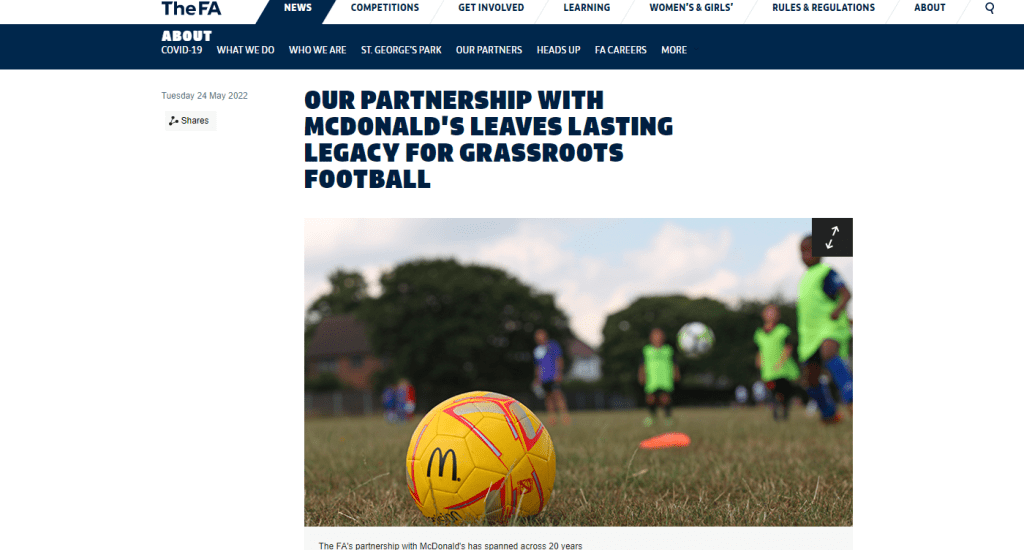
During the period of 20 years (2002-2022), the FA and McDonalds have provided millions of hours of free football for children across the country and have ensured that thousands of grassroot clubs have benefited from the support. They’ve helped train over 20,000 football coaches, run community football days and have equipped thousands of FA accredited football clubs with brand new kits, bibs, balls and other items of equipment each season. Although their partnership has recently concluded, it has left a long lasting legacy on society. The Chief executive of the FA Mark Bullingham said that the FA’s partnership with fast food chain McDonalds “has helped to positively change lives by giving millions of young people the opportunity to get involved and participate in grassroots football“.
The FA in 2010
The year 2010 was a particularly important year for the FA. Due to technological advancements and convergence, they utlised social media alongside the traditional media to engage fans during the 2010 South Africa World Cup. This was the first World Cup to take place in a ‘mature social media age’. They managed this through the tv channel ‘FATV’ which can now be found on YouTube. Additionally, they launched a campaign in the same year called ‘Grow the game’. It offered grants of £1,500 towards community football clubs (grassroots clubs) who wished to establish new teams and this year also focused on catering for female players as well as those with disabilities. The £1,500 sum helps reduce the costs associated with starting up a new grassroots football team and includes FA coaching courses, FA league affiliation costs, first aid kits, referees’ fees as well as football kit attire and other equipment. It allows for an easier way for kids to get involved in football knowing that finding a team to play for is a daunting task. It is crucial for the FA that they encourage as many kids male, female, LGBTQ+ and those with varying disabilities to play this universal sport as it plays a big part in our economy as well as our social lives and its important that both the men and women’s games continue to develop.
Survive, revive and thrive
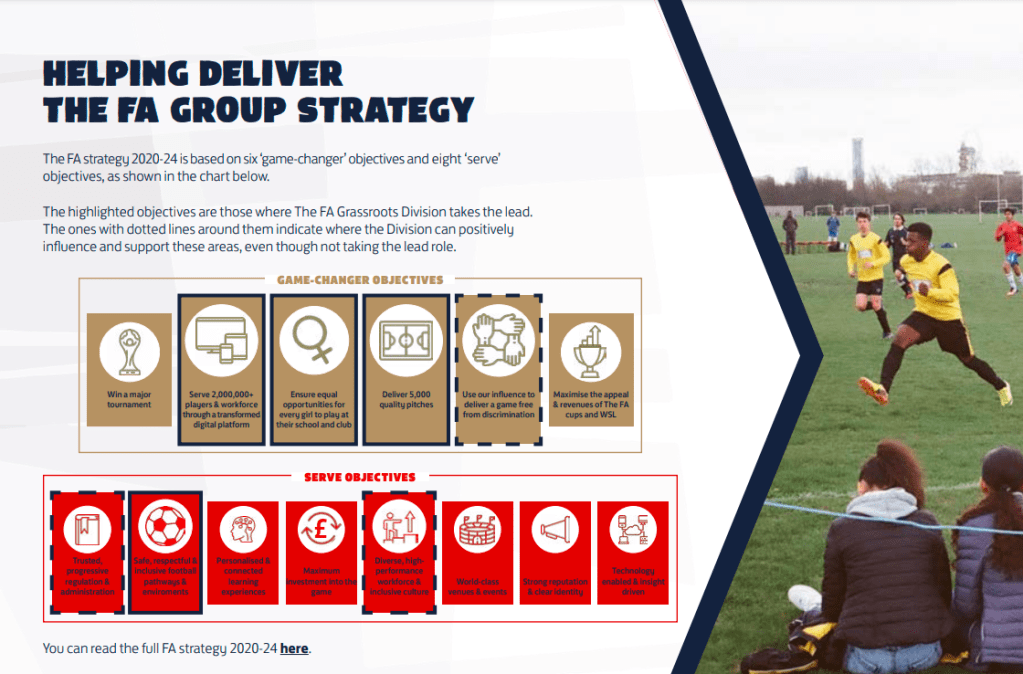
Furthermore, the FA has put in place a new strategy from 2020-2024 which was revealed in an online booklet published in March 2021. The strategy is called ‘Survive, revive and thrive’ and is based on six ‘game-changer’ objectives and additionally eight ‘serve’ objectives.
In the report, the FA states that grassroots football can be a re-igniting force for the community e.g. towns, cities and rural villages everywhere, and in the process, the game can be a catalyst for improved physical and mental health. Due to the new digital age we live in, the FA has said that it provides them with ‘a wonderful opportunity to unite the segments of grassroots football as never before, so that players, coaches, referees, league/club officials and volunteers all feel part of a connected family to take the game confidently forward‘. This has no doubt been influenced by the global pandemic which has meant that we have found a new reliance on technology in order to communicate with people socially and professionally. The data collected by the FA from past years suggest that the game has a significant impact in many different sectors. A total of 14.1 million people play grassroots football in England across all forms and frequencies and 13.5 million of these are regular participants. This in turn directly contributes around £10.16 billion to society each year. Of this £10.16 billion, around £7.74 billion goes towards helping improve the economy, £1.62 billion is saved from total healthcare and £780 million is social value. This highlights the importance of engaging as many people as possible in a sport such as football because there will be many winners as a result. For example, children participating in football has lead to the reduction of 66.5k cases of depression and anxiety as well as a staggering 213.5k cases of obesity. The latter in particular is a major concern especially because there has been an uptake in fast food and watching TV (another pandemic related issue), but also a decrease in the amount of physical activity. The sport really does impact the physical and mental wellbeing of children up and down the country. A study conducted found that children who play football are found to be more confident and resilient than those who don’t play the sport. Ultimately, it’s giving them some valuable life skills therefore helping to build more rounded human beings in the process. For adults, participation helps reduce 203.2k cases of physical and mental health disorders which include chronic disease, depression and anxiety. Adults who play the sport more frequently are fond to be generally happier. The FA states that this is particular true regarding the low socio-economic groups which is not surprising as football has historically been a working class game. For older adults, walking football has aided the improvement of mobility or coordination for 88% of the players surveyed by the FA. There are a 74% who now feel a sense of belonging because of it and has given 65% a sense of purpose. There’s also a total of two hours of social interaction for them each week. This is fantastic news considering the prominent loneliness problem we have in society whereby in 2019 we unfortunately had a total of 3.258 million over 70 year old’s living alone in the UK.
Both male and female participation in football is something which the FA strongly encourages and they want to ensure that they have the most relevant and modern offering for both genders whilst also safe proofing the sport and making it enjoyable for all. By 2024, the FA want to improve male player retention by having at least 25% fewer leaving football at specific life stages compared to when they have traditionally stopped playing. This is the key criteria for measuring their success in this department. This all starts by providing an inclusive and quality introduction into the sport and making it an engaging and enjoyable experience and also to maintain the interest amongst 5-11 year old boys. Additionally, diversifying the 12-18 male player pathway is also at the heart of their strategy. This is evident as Davide Reeve (FA Senior National Development Manager) stated that “the provision of football for men and boys cannot stand still. We have to be innovative if the game is to grow and be fit for a diverse, modern generation“. Another target of theirs is to aid the adults by providing opportunities to prevent a decline in participation for men over 35 and to increase the number of male participants over 50. For females, the game has grown exponentially over the last few years and the progress the England Women’s team has made by winning the Euros in 2022 showcases the vast improvement in the standard of women’s football in this country and is hopefully the catalyst for continued growth in the sport. By 2024 the FA want to see equal access to football for girls in 90% of primary and secondary schools and in 75% of clubs. This will help ensure that more girls become invested in football and realise that there is a career for them if they put in the hard work. Louise Gear (head of development for the FA) summarises this by saying “we’re committed to football playing its part in this country’s young women becoming physically and emotionally healthier, more resilient and self-confident“.
In addition to male and female participation, the other strategies include: positive environment, club network, facilities, grassroots workforce and digital products and services.
- Positive environment – The FA is ensuring that inclusion is at the forefront of its grassroots football programmes and other echelons of the game. This is to reduce any type of discrimination so that it’s completely eradicated from the game in its entirety. It’s to make everyone feel safe and able to enjoy playing a sport they love without facing any negativity or hostility from others.
- Club network – The FA want to establish a club network which supports the future needs of the game. They want to support and guide clubs along the way to become self-sufficient and effectively operating organisations so that they become FA-Accredited clubs.
- Facilities – The FA wants to invest in better quality services, predominantly improved pitches. By 2024 they hope to see 5,000 good quality pitches added to the current number. It also includes providing the right tools and finance which the facility owners require in order to improve and sustain the quality of the pitches.
- Grassroots workforce – This is the FA’s strategy to help retain volunteers of the game of which they believe is of the upmost importance. They want to ensure that the support is there so that they can perform to full capacity with confidence and expertise. They state it can be done via central’ local and peer-to-peer learning.
- Digital products and services – The FA’s main plan is to improve the already existing FA matchday app so that organising and playing football is easier and more accessible. By 2024 they want to see 2 million players, parents, coaches etc engaged and benefiting from their new digitalised products and services.
 FOOTBALL FOOD FOR THOUGHT
Leave a comment